Extremity Adjustments
Extremity adjustments restore proper joint motion, decrease inflammation, and improve comfort and function.
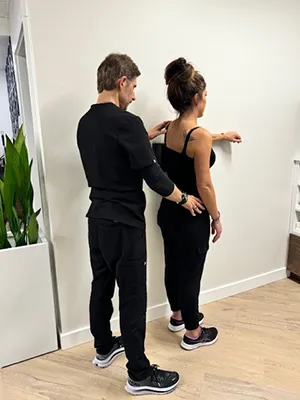
Addressing the Joints Beyond Your Spine
Most people think of chiropractic care as being exclusively about the spine, but the truth is that every joint in your body needs to move properly for you to feel and function your best. At Lakeside Spine and Wellness, Dr. Andrew Winger provides extremity adjustments that address dysfunction in the shoulders, elbows, wrists, hands, hips, knees, ankles, and feet.
These joints are subject to the same kinds of misalignment, restriction, and dysfunction that affect the spine. When they are not moving correctly, you compensate — and those compensations can lead to pain, reduced performance, and problems elsewhere in the body, including your spine.
How Extremity Dysfunction Develops
Extremity joint problems develop from a variety of causes. Repetitive motions at work or during sports can create overuse injuries. A fall, car accident, or awkward movement can shift a joint out of its optimal position. Even poor posture and spinal misalignment can change the way forces are distributed through your arms and legs, leading to secondary joint problems.
When a joint in your shoulder, wrist, knee, or ankle loses its normal range of motion, the surrounding muscles tighten, inflammation builds, and the joint begins to wear unevenly. Without correction, what starts as minor stiffness can progress to chronic pain and even degenerative changes.
What Extremity Adjustments Involve
An extremity adjustment is a specific, controlled correction applied to a joint outside the spine. Dr. Winger evaluates the affected joint through range of motion testing, palpation, and functional assessment to identify exactly where the restriction or misalignment exists.
The adjustment itself is typically gentle and precise. Depending on the joint and the nature of the problem, Dr. Winger may use manual techniques, instrument-assisted adjusting, or mobilization methods to restore proper motion. Most patients experience immediate improvement in their range of motion, and many notice a significant reduction in pain after just a few visits.
At Lakeside Spine and Wellness, extremity adjustments are often combined with spinal care because the body functions as an integrated system. A hip that is not moving properly affects your gait, which affects your lower back. A restricted shoulder changes how you carry yourself, which impacts your neck and upper spine. By addressing the whole picture, we produce better and more lasting results.
Conditions That Respond to Extremity Care
Patients in our Renton office seek extremity adjustments for a wide range of conditions:
- Shoulder pain and frozen shoulder — restricted motion and inflammation in the glenohumeral joint
- Tennis elbow and golfer’s elbow — overuse injuries affecting the forearm and elbow
- Carpal tunnel symptoms — wrist restriction contributing to nerve compression
- Hip pain and bursitis — joint dysfunction that alters gait and causes referred pain
- Knee pain — tracking issues, meniscus irritation, and post-surgical stiffness
- Ankle sprains and instability — joints that never fully recovered from an old injury
- Plantar fasciitis — foot and heel pain related to biomechanical dysfunction
- TMJ dysfunction — jaw joint problems that cause pain, clicking, and headaches
Many of these conditions persist or recur because the underlying joint dysfunction was never addressed. Pain medication and rest may reduce symptoms temporarily, but without restoring proper joint mechanics, the problem returns.
Who Benefits from Extremity Adjustments
Athletes are among the most frequent recipients of extremity care because their joints endure significant stress during training and competition. Runners with knee or ankle issues, tennis players with elbow problems, and swimmers with shoulder dysfunction all benefit from having these joints properly aligned and moving freely.
But athletes are not the only ones who benefit. Office workers with wrist and shoulder complaints, tradespeople with repetitive strain injuries, and older adults dealing with joint stiffness all see improvement with extremity adjustments. Even children can develop extremity joint problems from falls, sports, and growth-related changes.
How It Connects to Corrective Care
At Lakeside Spine and Wellness, we view the body as a connected structural system. Your spine is the central framework, but the extremities are integral to how that framework functions day to day. When we correct spinal alignment through our CBP-based corrective care program, we also need to ensure that the extremities are supporting that correction rather than working against it.
For example, a patient with a lateral pelvic tilt may also have hip and knee dysfunction that needs to be addressed for the spinal correction to hold. A patient with forward head posture may have restricted shoulders that are contributing to the postural pattern. By treating the whole system, we help your body achieve and maintain better structural balance.
Take the Next Step
If you are dealing with joint pain, stiffness, or dysfunction in your shoulders, elbows, wrists, hips, knees, or ankles, extremity adjustments at Lakeside Spine and Wellness may be exactly what you need. Dr. Winger will evaluate your joints, identify the source of your problem, and develop a plan to restore proper function.
Call (425) 276-8044 or Request Appointment to schedule your evaluation at our Renton office.
Ready to Get Started?
Contact us today and take the first step. Free consultations available.